Incremental Builds
This page explains what go2nix actually puts in the Nix store, what gets
reused on rebuilds, and how that differs from buildGoModule.
If you only want the API surface, see Builder API. If you want the step-by-step eval flow, see Default Mode.
The shape of a build
buildGoModule (nixpkgs)
┌──────────────────────────┐     ┌──────────────────────────┐
│ vendor FOD               │ ──▶ │ app derivation           │
│ (all modules, one hash)  │     │ (go build ./..., 1 drv)  │
└──────────────────────────┘     └──────────────────────────┘
Two derivations total. Any change to any .go file rebuilds the whole app
derivation; any go.sum change re-downloads the entire vendor tree.
go2nix (default mode)
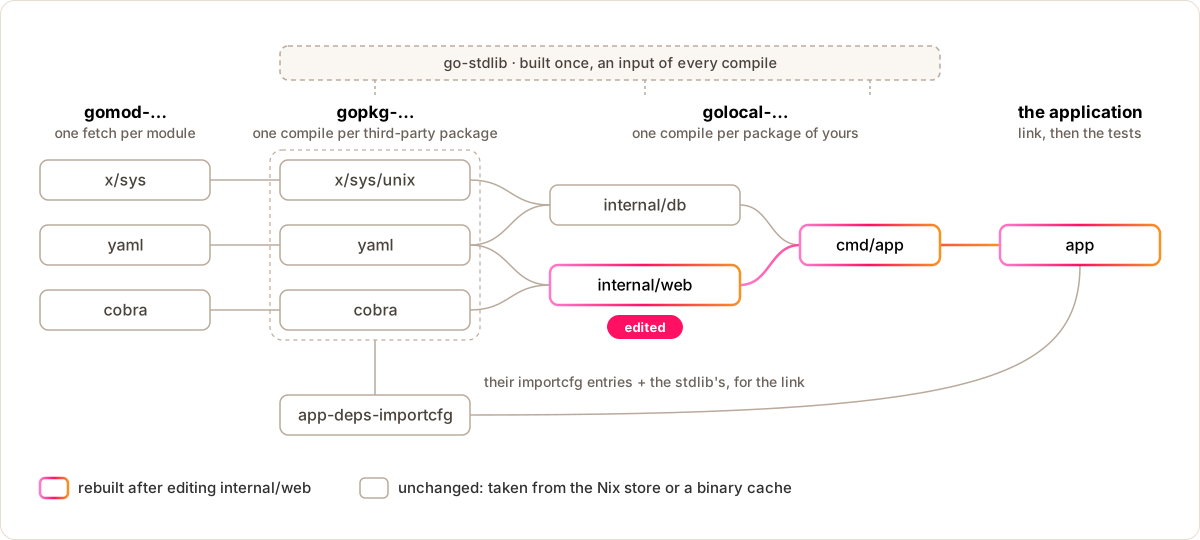
The same thing by layer:
  module FODs                        one fixed-output derivation (FOD)
       │                             per module@version the build uses
       ▼
  third-party package drvs (.a)      one per imported third-party package
       │                  │
       ▼                  ▼
  local package drvs     importcfg bundle     bundle = stdlib + third-party
  (.a; plus .x with      (one per app)        entries, no local packages
   contentAddressed)          │
       │                      │
       └──────────┬───────────┘
                  ▼
              app drv                compiles the main package(s), links,
                                     and runs the tests (doCheck)

  stdlib drv ──► an input of every compile and of the bundle
                 (Go toolchain + scope goEnv only)
.a = compiled package archive; .x = export-data interface, which only
local packages get and only with contentAddressed = true (see
Early cutoff below). The
importcfg is a file that maps each import path to its compiled .a
archive in the store — go tool compile and go tool link read it instead
of searching GOPATH.
For a non-trivial application this is hundreds to thousands of derivations instead of two — but almost all of them are reusable across rebuilds.
What gets cached
| Layer | One derivation per | Cache key (informally) | Rebuilds when |
|---|---|---|---|
| stdlib | Go toolchain and scope goEnv | Go version + goEnv (GOOS/GOARCH when cross-compiling, CGO_ENABLED, GOFIPS140, …) | Go is bumped or goEnv changes |
| module FOD | module path@version the build uses | module path@version + NAR hash | that module is bumped |
| third-party package | imported package | module FOD + import deps + tags + gcflags | the module or any of its transitive deps change |
| local package | local Go package | the package’s directory (every file in it, _test.go and testdata/ included, nested packages excluded) + import deps | any file in that directory or a dep changes |
| importcfg bundle | app | the stdlib and the third-party package outputs | a third-party package output changes |
| app | app | importcfg bundle + local package archives + the filtered source (mainSrc: with doCheck, every local package’s sources, tests and testdata/) | anything above changes |
Third-party module FODs and third-party package derivations are shared between every application in the flake (and across flakes, via the binary cache). Bumping a single module re-fetches one FOD and recompiles only the packages that transitively import it.
Local package derivations use a builtins.path-filtered source: only the
package’s own directory is hashed — its whole subtree, minus nested package
directories and nested modules, and whatever srcFilter rejects — so editing
pkg/a/a.go does not change the input hash of the pkg/b derivation unless
b imports a. No go.mod comes along (the go directive is passed in
separately). Everything in the directory counts, not just what gets compiled:
embedded assets, but also _test.go files, testdata/ and a README next to
the sources participate in the package’s cache key.
Rebuild propagation
When you edit a single local package, only the reverse-dependency cone of that package rebuilds:
- The edited package recompiles.
- Each package that imports it (directly or transitively) recompiles.
- The final derivation rebuilds: it compiles the main package, links, and runs the tests. The importcfg bundle does not: it only holds standard library and third-party entries, which a local edit does not touch.
Packages outside the cone keep their existing store paths and are not rebuilt.
The same reasoning for other kinds of change:
| You change | What rebuilds |
|---|---|
a file in a local package’s directory (source, test or testdata/) | that package, the local packages that import it directly or transitively, and the app. With contentAddressed = true the dependents are skipped when the package’s export data came out the same, which is always the case for a test-only edit |
| an import between packages that already exist | the importing package and its cone. Nothing to regenerate: the lockfile pins modules, not the graph |
| one module’s version | its FOD, the packages of that module, everything that imports them, the importcfg bundle and the app |
| a test-only dependency | its testPackages derivations, the test importcfg bundle and the app (relink, tests re-run) |
ldflags, checkFlags | the app only |
tags, gcflags, pgoProfile | every package compile (they are part of each compile manifest), then the bundle and the app. The stdlib is not affected |
the scope’s goEnv, or the Go toolchain | the stdlib, and everything after it |
To get a feel for how big the cone is in your project, see Benchmarking.
Early cutoff with contentAddressed = true
By default, per-package derivations are input-addressed: if a package’s inputs change, every downstream derivation gets a new store path even if the compiled output happens to be byte-identical.
Setting contentAddressed = true opts into two coupled mechanisms:
- Floating-CA outputs. Local-package derivations and the importcfg bundle
become content-addressed, so a rebuild that produces a byte-identical
.aresolves to the same store path and short-circuits downstream rebuilds. Third-party packages stay input-addressed: their source never changes, so CA would only add resolution overhead. ifaceoutput split. Each local-package derivation gains a secondifaceoutput containing only the export data (the.xfile produced bygo tool compile -linkobj). Downstream compiles depend onifaceinstead of the full.a, so changes to private symbols that don’t alter the package’s exported API don’t cascade. This mirrors the.xmodel used by Bazel’srules_go.
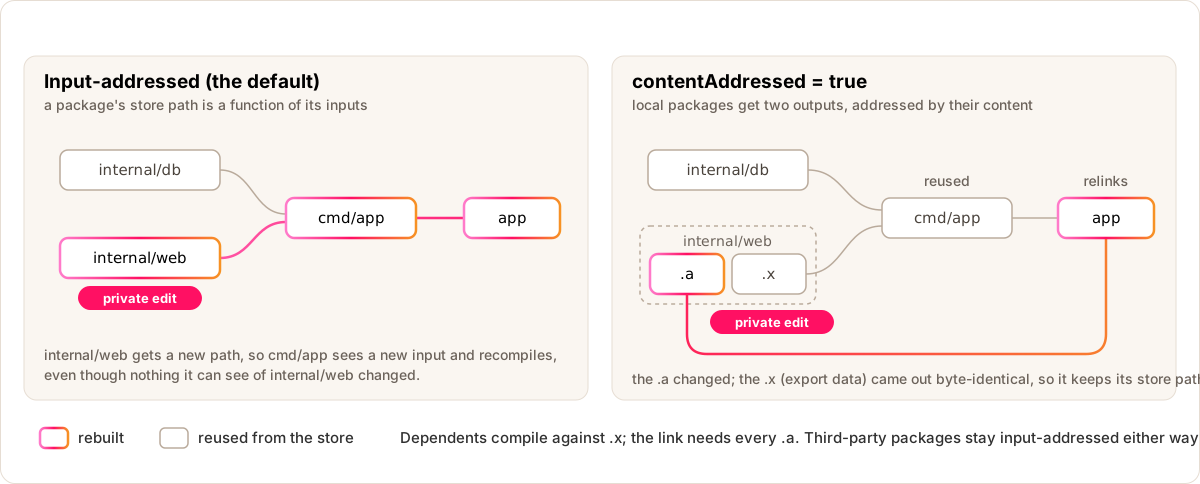
The two are coupled by design: CA without iface only short-circuits
comment-only edits, and iface without CA can’t cut off anything because
the input-addressed .x path still changes whenever src changes.
Requires the
ca-derivationsexperimental feature in Nix. The final binary stays input-addressed.Known limitation: adding the first package-level initializer to a previously init-free package still flips a bit in the
.xfile, so that particular edit cascades even though the API didn’t change. This is rare in practice.
The cost: eval time
go2nix trades build time for eval time. Every nix build evaluation:
- Calls
builtins.resolveGoPackages(the Nix plugin), which runsgo list -json -depsagainst your source tree — with-testwhendoCheckis on, which is the default. - Instantiates one derivation per package in the resulting graph.
For a large application (~3,500 packages) the warm-cache go list step
takes on the order of a few hundred milliseconds, and instantiation
adds a similar amount on top. This is the floor on every rebuild — even a
no-change rebuild — and is the main reason go2nix is overkill for small
single-binary projects.
The plugin call is impure (it reads GOMODCACHE), so the result is not
cached by the Nix evaluator across invocations. See
Nix Plugin for details.