Default Mode
Per-package Nix derivations at eval time, with fine-grained caching.
Overview
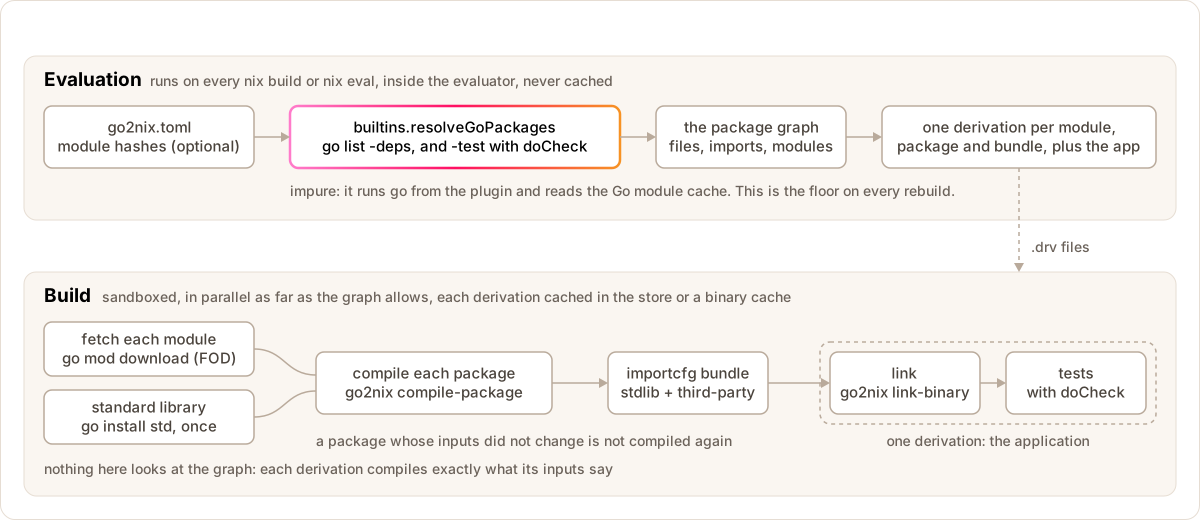
The default mode creates per-package derivations from an eval-time package
graph. The go2nix-nix-plugin runs builtins.resolveGoPackages to discover
third-party packages, local packages, local replaces, module metadata, and
optional test-only packages when checks are enabled. Module hashes come from
the lockfile’s [mod] section, or from the plugin itself when there is no
lockfile; replace directives that point at another module change where a
module is fetched from. When a single dependency changes, only it and its
reverse dependencies rebuild.
Lockfile
The lockfile is optional. With one, module hashes are pinned in a file you review and commit:
go2nix generate .
It contains only module hashes — the package graph is resolved at eval time by the plugin, so it does not need to be regenerated when import relationships change, only when modules are added, removed or bumped.
Without one (goLock left out or null), the plugin computes the hashes
from go.sum and the module cache while evaluating; see
Lockfile-free builds.
Nix evaluation flow
1. Module hashes (builtins.fromTOML, or the plugin)
With a lockfile, it is parsed at eval time with builtins.fromTOML and module
metadata (path, version, hash) is read from its [mod] section; that is the
only section the Nix side reads. Without one, the same table comes from the
plugin’s moduleHashes.
2. Package graph discovery (builtins.resolveGoPackages)
The go2nix-nix-plugin runs go list -json -deps against the source tree at
eval time and returns the package graph (third-party, local, test-only, and
replacement metadata) — see Nix Plugin
for the full return shape.
replace directives that point at another module come back as the plugin’s
replacements and rewrite each module’s fetchPath and version, so that
FODs download from the right place. Modules replaced with a directory are not
fetched at all: their packages are local packages.
3. Module fetching (fetch-go-module.nix)
Each module is a fixed-output derivation (FOD) that runs go mod download and
keeps only the extracted source tree: $out is the module’s directory
(what would be <escaped-path>@<version>/ in a module cache), without the
cache/download metadata, so the hash does not depend on which proxy served
it.
GOPROXY and NETRC are inherited from the builder’s environment unless the
goProxy argument pins a proxy in the derivation; the netrcFile option
supports private module authentication.
4. Package derivations (default.nix)
For each third-party package in goPackagesResult.packages, a derivation is
created. nix/dag builds a JSON compile manifest for it (the importcfg
parts of its dependencies and of the standard library, build tags, gcflags,
the PGO profile, the package’s file lists) and the derivation passes it to
go2nix compile-package --manifest.
Pure-Go packages — almost all of them — are a bare builtins.derivation
whose builder is bash running a short inline script: no stdenv, no phases,
just go and coreutils on PATH. CGO packages (where pkg.isCgo is true)
are a stdenv.mkDerivation using the compile-go-pkg.sh setup hook (from
nix/dag/hooks/), with stdenv.cc added to nativeBuildInputs.
Dependencies (deps) are resolved lazily via Nix’s laziness — each package
references other packages from the same packages attrset.
5. Local package derivations
Each local package in goPackagesResult.localPackages (and, under doCheck,
testLocalPackages) also gets its own derivation. Its source is a copy of
that package’s directory only — rooted at the directory itself, with nested
package directories and nested modules left out, and the caller’s srcFilter
applied — so editing a neighbouring package does not change it. Local package
dependencies can point to other local packages and to third-party packages.
Packages of a module replaced with a directory compile with that module’s own
go directive and module@version. With contentAddressed = true these are
the derivations that become content-addressed and gain an iface output.
6. Importcfg bundles
Instead of passing every compiled package as a direct dependency of the final
application derivation, the default mode builds bundled importcfg derivations:
depsImportcfg: stdlib + third-party packages. Local packages are not in it; their archives reach the link through the link manifest, so a local edit leaves the bundle untouchedtestDepsImportcfg: adds test-only third-party packages whendoCheck = true
This keeps the final derivation’s input fan-in small while preserving fine-grained package caching.
7. Application derivation
The final derivation receives typed JSON manifests via environment variables
and uses goAppHook (link-go-binary.sh) to invoke the Go CLI:
- Build phase — writes
linkManifestJSONto a file and callsgo2nix link-binary --manifest, which validates the lockfile againstgo.mod(when there is a lockfile), generates modinfo, compiles main packages, and invokes the linker. - Check phase — writes
testManifestJSONto a file and callsgo2nix test-packages --manifest, which discovers testable local packages, compiles test archives, and runs them.
Package overrides
Per-package customization (nativeBuildInputs for cgo packages, env,
srcOverlay) is supported via packageOverrides — see
Package Overrides for lookup rules and recipes.
Directory layout
nix/dag/
├── default.nix            # buildGoApplication
├── fetch-go-module.nix    # FOD fetcher
└── hooks/
    ├── default.nix        # Hook definitions
    ├── setup-go-env.sh    # GOPROXY=off, GOSUMDB=off
    ├── compile-go-pkg.sh  # Compile one cgo package (pure-Go ones skip stdenv)
    └── link-go-binary.sh  # Link binary and run checks
Trade-offs
Pros:
- Fine-grained caching — changing one dependency doesn’t rebuild everything
- No experimental Nix features required (
contentAddressed = trueis opt-in and needsca-derivations) - Small lockfile (module hashes only), or none at all
- Lockfile only changes when modules are added, removed or bumped, not when imports change
- Automatic CGO detection and compiler injection
Cons:
- Requires the go2nix-nix-plugin (provides
builtins.resolveGoPackages), built against the Nix that evaluates (2.34 or newer) - Many small derivations can slow Nix evaluation on very large projects
Compilation and linking are handled by the builder hooks and direct
go tool compile / go tool link invocations described above.