Builder Modes
A Go application is made up of modules (downloaded units, each with a
go.mod) and packages (individual directories of .go files within a
module). A single module can contain dozens of packages. Both builder modes
turn each package into its own Nix derivation; they differ in when the
package graph is discovered and what that requires of your Nix setup.
| Mode | How it works | Lockfile | Caching | Requires |
|---|---|---|---|---|
| Default | go tool compile/link per-package | optional (module hashes) | Per-package | go2nix-nix-plugin, built against the evaluating Nix (>= 2.34) |
| Experimental | Recursive-nix at build time | required ([mod] + optional [replace]) | Per-package | Nix >= 2.34 with dynamic-derivations, ca-derivations, recursive-nix |
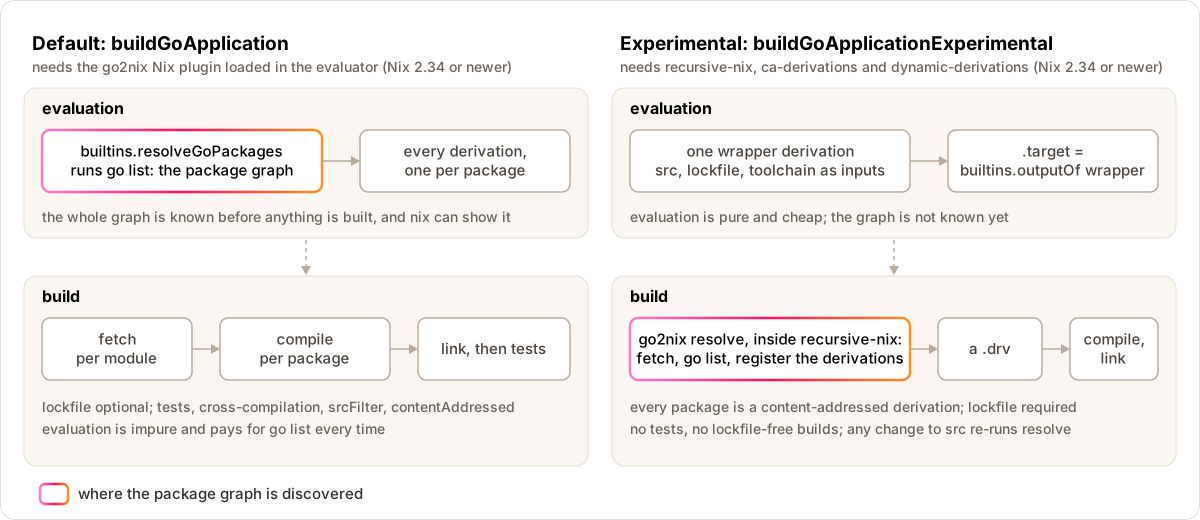
-
Default (
buildGoApplication): every package (not just every module) gets its own derivation. go2nix callsgo tool compileandgo tool linkdirectly, bypassinggo build. The import graph is discovered at eval time by the go2nix-nix-plugin (builtins.resolveGoPackages), so the lockfile holds module hashes only, and can be left out altogether. When one package changes, only it and its reverse dependencies rebuild. -
Experimental (
buildGoApplicationExperimental): same per-package granularity as the default mode, but discovers the import graph at build time inside a recursive-nix wrapper instead of at eval time. The lockfile stays small ([mod]plus optional[replace]) and only changes when module resolution changes. Requires Nix >= 2.34 with experimental features enabled.
Choosing a mode
Use buildGoApplication (the default) for the best balance of caching and
simplicity — the lockfile is small (just module hashes) or absent, and the
go2nix-nix-plugin resolves the package graph at eval time.
Use buildGoApplicationExperimental only if you have Nix >= 2.34 with
dynamic-derivations, ca-derivations, and recursive-nix enabled, and
want per-package caching without requiring the plugin.
# Default (recommended):
goEnv.buildGoApplication { ... }

# Experimental (requires nix experimental features):
goEnv.buildGoApplicationExperimental { ... }